The initial impression when launching a new site is excitement, but then you open Google Search Console, and you get impressions with nearly no clicks. Frustrating, right? This is among the most usual stages every new site passes through. Google initially checks your site by displaying it to users before determining whether you are worthy of more exposure. It is there that the correct SEO strategy comes in.
This guide is a practical explanation of SEO for new websites. No jargon. No fake promises. Only practical steps that will assist you in reaching your 100 clicks on Google, even when your site is new.
What SEO for New Websites Really Means
SEO of the new websites is not about how to rank in the first place overnight. It is concerned with the development of trust, relevance, and click signals sequentially. Google does not place a lot of faith in new sites and will display your pages with caution and monitor the response of the users. Google gains visibility bit by bit as people click, remain, and interact.
Small wins to be considered by new websites need to be small, low-competition keywords, higher CTR, and clear intent matching. Consistency means growth will come easily to Google.
Key points to remember:
New websites begin with low trust.
Google is ranking pages that it has already tested.
At this point, clicks are more important than impressions.
Why New Websites Get Impressions but No Clicks
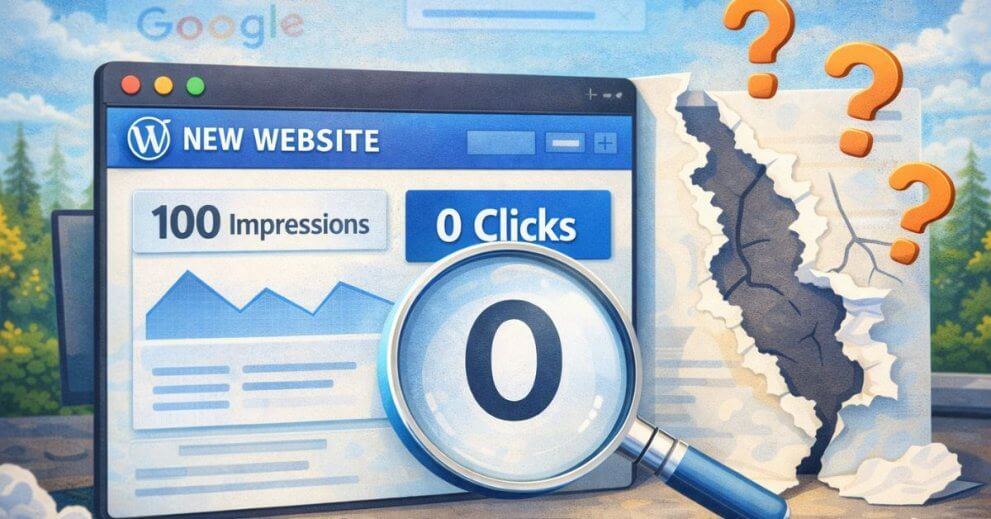
The reason for the new website impressions and no clicks is due to this reason.
When impressions are coming, but no click is happening, it is a good thing. It entails Google knowing what you are talking about,t but the users are not persuaded to take the next step. This normally arises as a result of poor titles, no clear meta description,n or inadequate intent match. Lots of novices believe that bad SEO is associated with traffic issues; however, in truth, it is more likely to be a CTR issue.
Google evaluates the reaction of the users to your listing. Rankings can remain stagnant unless people pay attention. Rankings are fixed by fixing clicks.
Common reasons include:
Boring or generic SEO titles
Uninquisitive meta descriptions.
Ranking on page 2 or lower
Attacking the irrelevant keywords.
None of the evident benefits were demonstrated to the user.
The first step is to identify low competition keywords.
High competition should not be the starting point of new websites. Authority sites that are years old dominate the big keywords. Rather, the most clever SEO step is to focus on long-tail and problem-based keywords, which are being searched by real users.
These are low-volume keywords, which yield actual clicks, and are far simpler to rank. Google also relies on these initial victories to determine the quality of your site.
The good types of keywords include:
SEO for new websites
Why, how to get first clicks with Google?
Why does my site have views and not clicks?
How to use Google Search Console: beginner tutorial.
Write SEO Titles That Attract Clicks
It is worthless to be ranked without clicks. SEO titles are essential to new websites, hence the reason. What you are offering should be clear and concise in your title so as to convince the user to visit your page and not the other pages.
One that has a strong title addresses the issue of the user and provides a definite answer. CTR is enhanced immediately using numbers, questions, and emotional triggers.
What makes a good SEO title:
Under 60 characters
Consists of the major keyword.
Uses numbers or curiosity
Focuses on user benefit
Must optimize Meta Descriptions with CTR.
The meta descriptions do not have any direct effect on rankings, but compellingly affect clicks. Consider them as a mini sales pitch. When the person reads what you are describing, he or she should think, this is precisely what I require.
Meta descriptions must be straightforward and problem-oriented in the case of new websites. Do not stuff your keywords and write in a human manner.
Best practices of meta descriptions:
Under 160 characters
Mention the main problem.
Promise a clear solution.
Use natural language
Account Content-Search Intent.
Search intent refers to the reason why one searches for a keyword. Unless your content is aligned with such a purpose, Google will not reward it. The new websites have to be particularly cautious in this regard since they do not have many second chances.
When a user types in the query: SEO new websites, he or she wants to be coached and not taught. Elaborated steps, illustrations, and easy-to-understand explanations are the best.
To match intent properly:
Be direct in answering the question.
Avoid unnecessary fluff
Use step-by-step guidance
Write for beginners first.
Have Internal Linking to gain authority.
One of the quickest ways of boosting SEO in new websites is through internal linking. It assists Google in knowing what pages are important, and the user is also kept longer. Strong internal linking can also boost the rankings even in the absence of the use of backlinks.
Any new blog must have related articles linked to it using descriptive anchor text, rather than random words.
Smart internal link anchors:
increase blog CTR
Whyy blogging is blogging popular yet not bringing revenue?
Google Search Console Guide
Blogging with WordPress
Find Quick Wins with the help of Google Search Console.
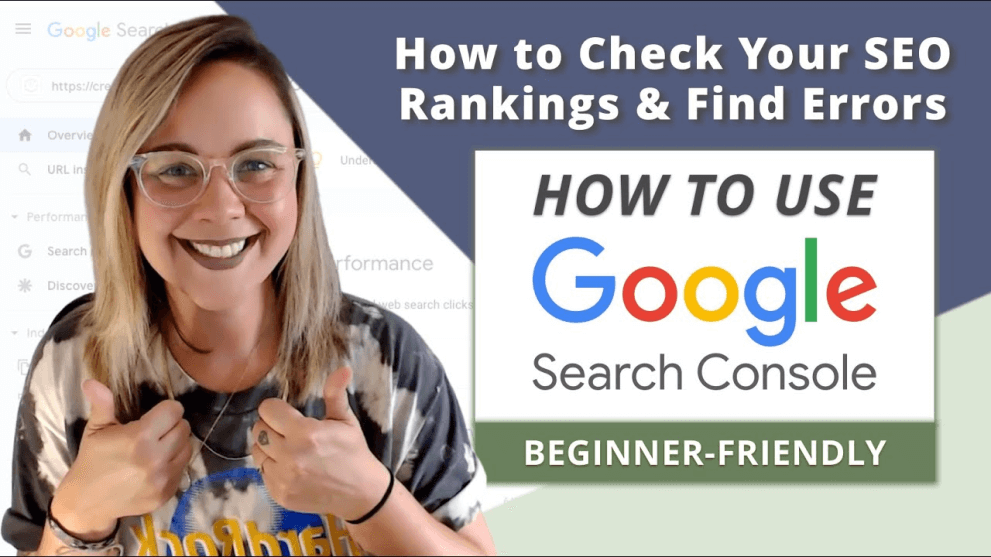
Google search engine console indicates precisely the areas with your weak SEO and the areas you can improve easily. The new websites should target the low CTR and high impression pages. These pages are already in place; they just should be optimized better.
Improvements in titles, meta descriptions, and introductions can be readily achieved in a few weeks.
Search engine items to be reviewed in Search Console:
Impression queries that do not get clicks.
Pages that lie between positions 8-30.
CTR below 3%
Top SEO Errors made by New Websites.
The majority of failures in SEO are due to the fact that newcomers take bad advice or are too impatient. Prevention of errors is usually more effective than the acquisition of new strategies.
Employees should be patient, focused, and consistent with new sites rather than short-cutting.
Mistakes to avoid:
Early competitive keyword targeting.
Lack of SEO titles in publishing.
Ignoring internal linking
Copying content from others
Expecting instant traffic
How to Get Your First 100 Clicks Faster.
When the fundamentals are correct, little enhancements will accelerate. It is more about consistency rather than about volume. You can get your first 100 clicks even with a few well-optimized articles.
Pro tips for faster results:
Post 2 blogs a week of high quality.
Concentrate on one of the key areas.
Add FAQs to every post.
Update titles after 14 days
Be simple with content.
Conclusion: Your First 100 Clicks Are Achievable
SEO for new websites is not about beating big sites; it’s about building trust step by step. When you focus on low-competition keywords, improve CTR, match search intent, and use internal linking correctly, Google starts rewarding your effort.
Those first 100 clicks are not just numbers. They are proof that your website is moving in the right direction. At Leadnad, we believe sustainable SEO growth starts with clarity, patience, and smart optimization, not shortcuts.
FAQs:
What is the time period for SEO in new websites?
Mostly 1-3 months till regular clicks.
Are new websites able to rank in Google?
Yes, particularly where there is low-competition.
Is SEO worth it for beginners?
Yes, SEO generates long-term free traffic.